Free Credit Card Churning Tool: 5/24 Tracker + Annual-Fee Calendar (Agent Skill)
Free credit card churning tool, in one line: it’s an Agent Skill — three commands your AI runs — that tells you whether you’re about to get auto-declined by Chase’s 5/24 rule, when each card’s annual fee is about to post, and what order to apply for cards in. One welcome bonus alone can be worth real money: Chase Sapphire Preferred’s current offer (75,000 points after $5,000 spend) is valued at $1,538 by The Points Guy’s July 2026 valuations, and its short-lived 100,000-point promo this year was worth close to $2,000. Get flagged by 5/24 without realizing it, or let a $95–$550 annual fee auto-renew because you forgot the date, and that’s the exact amount of money this tool exists to protect.
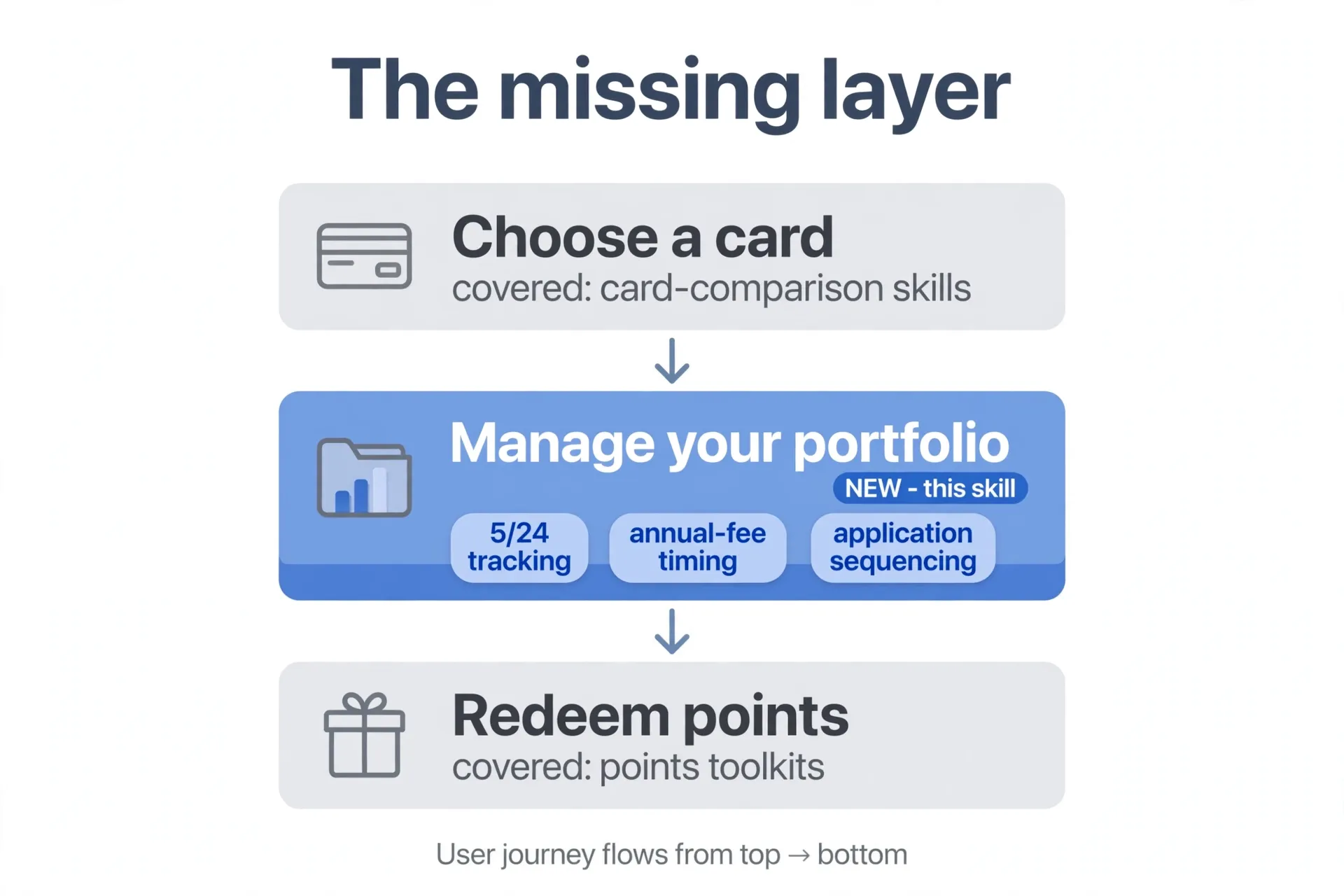
We didn’t rebuild what already works — there’s a great tool for choosing a card and another for redeeming points, both linked below. This one covers the layer in between: managing the cards you already have.
Walkthrough: are you actually locked out, or not?
This is an illustrative example — not a real user, not a testimonial — showing exactly what the skill outputs, so you can see the shape of the answer before you install anything.
Scenario: you’ve opened four personal cards in the last 20 months and now want the Chase Sapphire Preferred.
INPUT:
/cc-524-check I've opened: Amex Gold (Nov 2024), Capital One Venture X (Feb 2025),
Citi Premier (June 2025), Bank of America Travel Rewards (Jan 2026).
I want to apply for the Chase Sapphire Preferred.
OUTPUT:
5/24 STATUS: 4 of 5 (trailing 24 months, as of today)

Personal cards counted:
1. Amex Gold — opened Nov 2024 (rolls off your count in Nov 2026)
2. Capital One Venture X — opened Feb 2025
3. Citi Premier — opened June 2025
4. Bank of America Travel Rewards — opened Jan 2026

VERDICT: Chase Sapphire Preferred is reachable right now. You're at 4/5, and
Chase declines applicants at 5 or more cards in the trailing 24 months
[confirmed: Chase's published policy]. Applying today would put you at 5/5 —
exactly at the line, not over it.

⚠️ This is your last open slot. Any other card opened before your Amex Gold
rolls off in Nov 2026 — even a store card with a hard pull — pushes you to
6/24, and Chase will auto-decline on volume alone regardless of your credit
score. If you want more than one more card, decide which one you actually
want most before you apply for any of them.

Not financial advice — a rules-based projection from the cards and dates you gave it.
That’s the difference between guessing and knowing: a generic chatbot might approximate the 5/24 count, but it won’t track your rolling 24-month window or flag that you’re one application away from a two-year lockout.
What it does
| Command | What it does |
|---|---|
/cc-524-check |
Computes your Chase 5/24 status from the cards you list, and tells you whether a specific Chase card is realistically reachable right now — like the example above. |
/cc-annual-fee-calendar |
Projects upcoming annual-fee dates across your wallet and produces a keep/downgrade/cancel worksheet for each — a worksheet, not a verdict. |
/cc-application-sequence |
Given a list of cards you want, suggests an order that respects 5/24 and issuer-specific rules like Amex’s once-per-lifetime bonus restriction. |
A second quick example, so you’ve seen every command’s output shape at least once:
/cc-annual-fee-calendar Chase Sapphire Reserve, opened June 2024, $550/year.

→ Next fee post date: June 2027. 9 months out.
  Worksheet: did you clear $550 in Priority Pass / travel credits this
  cardyear? If yes, keep. If no, this is your downgrade-decision window —
  start it 60 days before the post date, not the week of.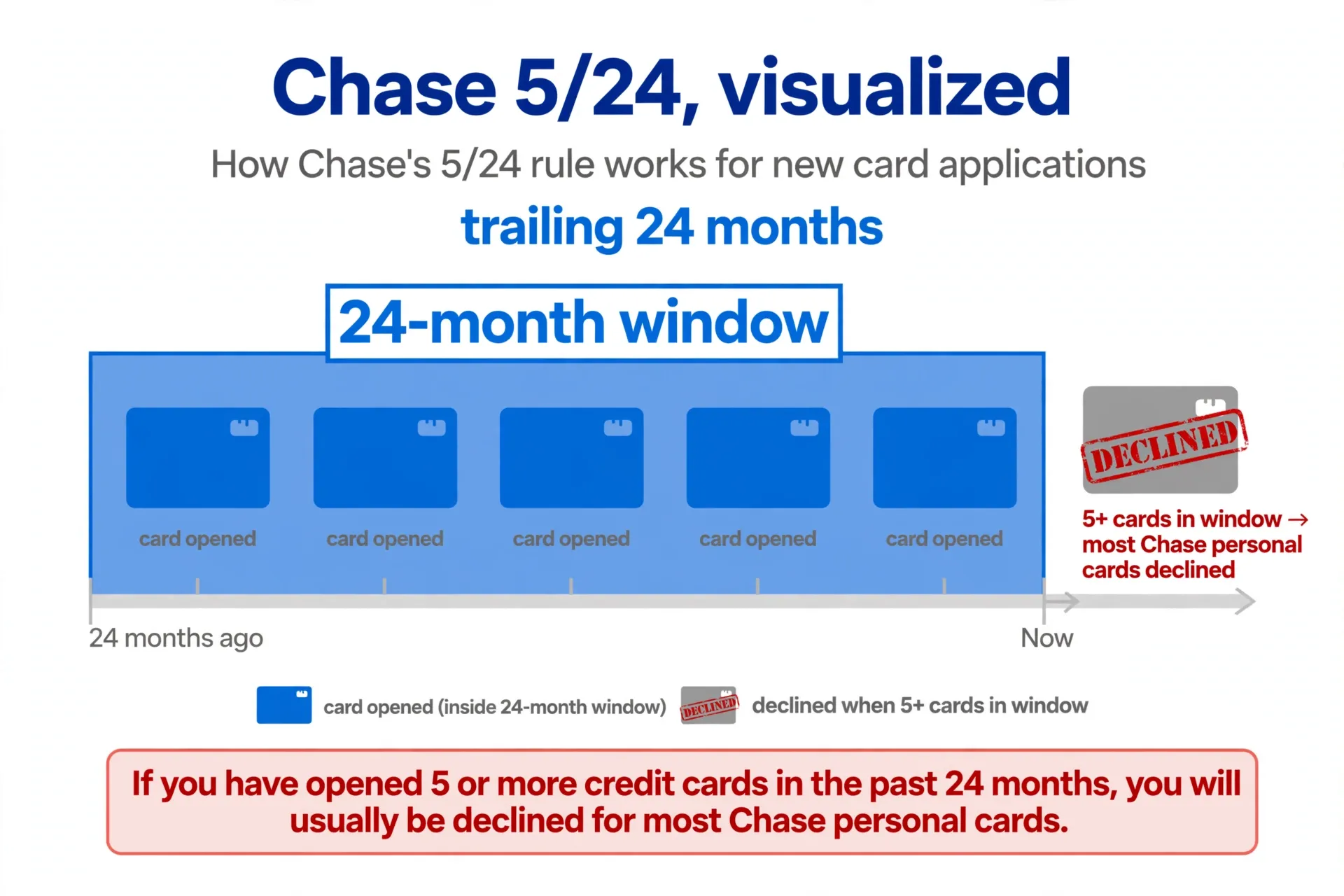
Install
git clone https://github.com/ezcat207/credit-card-portfolio-skill.git
bash credit-card-portfolio-skill/install.sh --all| Flag | Installs into |
|---|---|
--claude |
.claude/skills/ |
--codex |
.agents/skills/ |
--grok |
.grok/skills/ |
--all |
All three |
For ChatGPT, upload the contents of a skills/<name>/ folder through ChatGPT’s own skill-upload flow.
Try it now
Once installed, run either command with your own card history:
/cc-524-check [list your cards and open dates, and the card you want]

/cc-annual-fee-calendar [card name, open date, annual fee]
You’ll get a structured status and verdict like the walkthrough above, built from your actual dates — not a generic explainer of what 5/24 is.
What already exists (and why we built this instead of copying it)
Two real, well-built projects already cover the adjacent ground:
- jiahongc/credit-card-skills — 9 skills for researching and comparing cards (
/card-full,/card-compare,/card-value, and more), with a well-designed shared contract: a source-policy file scoping it to major US issuers with an allowlisted domain list, and a three-state confidence system (confirmed/unconfirmed/conflicting) for every claim. We reused that same confidence-labeling idea rather than inventing our own. - borski/travel-hacking-toolkit (681 stars) — a large, mature toolkit for redeeming points and miles: award search across 27 mileage programs, transfer-partner routing, cents-per-point valuation.
Between “which card should I get” and “how do I redeem my points,” neither one touches portfolio strategy — application sequencing, annual-fee timing, and the 5/24 rule. That’s the gap this skill fills.
FAQ
What’s an Agent Skill, and why not just ask my AI directly? A packaged set of instructions — a SKILL.md file plus optional scripts — that an AI agent follows the same way every time, instead of you re-explaining your card history and the 5/24 rule in every chat. Roughly 20 tools now support the standard, including Claude Code, Claude.ai, ChatGPT, Codex CLI, and Grok Build.
Why didn’t you build a card-comparison or points-redemption tool instead? Because good ones already exist and are free — see above. We looked for the actual gap instead.
Is this financial advice? No. It’s a research and tracking tool. Every output ends with a disclaimer, and any keep/downgrade/cancel decision is presented as a worksheet, not a recommendation, since that depends on your own spending patterns.
Do I need to be a developer to use this? You need an AI agent that supports Agent Skills and can run one install command. No coding beyond that.
How do you keep the numbers honest? Every rule is checked against a small allowlist of issuer pages and tagged confirmed, unconfirmed, or conflicting — issuers change these rules quietly, so the skill flags uncertainty instead of guessing.
References
- ezcat207/credit-card-portfolio-skill — this skill’s source, MIT licensed.
- jiahongc/credit-card-skills — the card-comparison skill this one deliberately doesn’t duplicate.
- borski/travel-hacking-toolkit — the points-redemption toolkit this one deliberately doesn’t duplicate.
- The Points Guy, Chase Sapphire Preferred current offer — $1,538 valuation on the 75,000-point welcome bonus, July 2026 monthly point valuations.
- Upgraded Points, Chase Sapphire Preferred 100K bonus — ~$2,000 valuation on the limited-time 100,000-point offer, July 2026.
- agentskills.io — the open Agent Skills standard.
Don't just read it — run the first job this week
Subscribe and get a 7-day validation checklist.
Subscribe free