Job Search Agent Skill: Spot Ghost Jobs Before You Waste Hours Applying
If you’ve sent out dozens of applications and heard nothing back, it might not be you. Independent estimates converge on roughly 1 in 5 to 1 in 7 job postings being “ghost jobs” — listings kept live for talent pipelining or salary benchmarking, with no real intent to hire from outside. Meanwhile the average posting now draws 240+ applications, about 3x the 2017 level. This job search agent skill is a free, open-source tool that runs inside Claude Code, Codex, or Grok and estimates — before you spend an evening tailoring a cover letter — whether a given posting is worth that time.
One line on scope: this isn’t a resume or cover-letter generator. That space is already crowded and well-served (more on that below). What it does instead is research and tracking — the parts a one-shot document generator can’t touch.
See it work: /job-verify on a real-shaped posting
Illustrative walkthrough — not a real company or posting, just a realistic example of the input/output shape.
Input:
/job-verify https://example.com/jobs/senior-backend-engineer — posted "2 days ago"
but I've seen this exact listing for 3 months. Company: Acme Corp (Series B,
last funding round 14 months ago, no recent layoff news found).
Output:
Ghost-job probability estimate: ~65% (moderate-high)

Reasoning:
- Re-post pattern: identical listing text observed under 3 separate "posted X
  days ago" timestamps over 3 months. Strong signal — most consistent with
  automatic ATS re-listing (Workday/Taleo auto-renew every 30-90 days) rather
  than a genuinely new opening.
- Company signal: no hiring-freeze or layoff news found for Acme Corp in the
  last 90 days. This cuts the estimate down somewhat — repeated reposting can
  also just mean a hard-to-fill role, not a fake one.
- Base rate: industry estimates put 1-in-5 to 1-in-7 postings as ghost jobs,
  so any posting starts around a 15-20% prior before other signals adjust it.

This is a probability estimate, not a confirmed fact about Acme Corp's hiring
intent.

Recommendation: don't skip it, but don't over-invest either — apply with your
standard materials in a few minutes rather than a custom-tailored letter, and
prioritize your polish time on postings with fresher signals.
That’s the whole point of the skill: instead of guessing, you get a specific probability with the signals behind it, and a concrete recommendation on how much effort the posting is worth.
Why ghost jobs are the real problem here
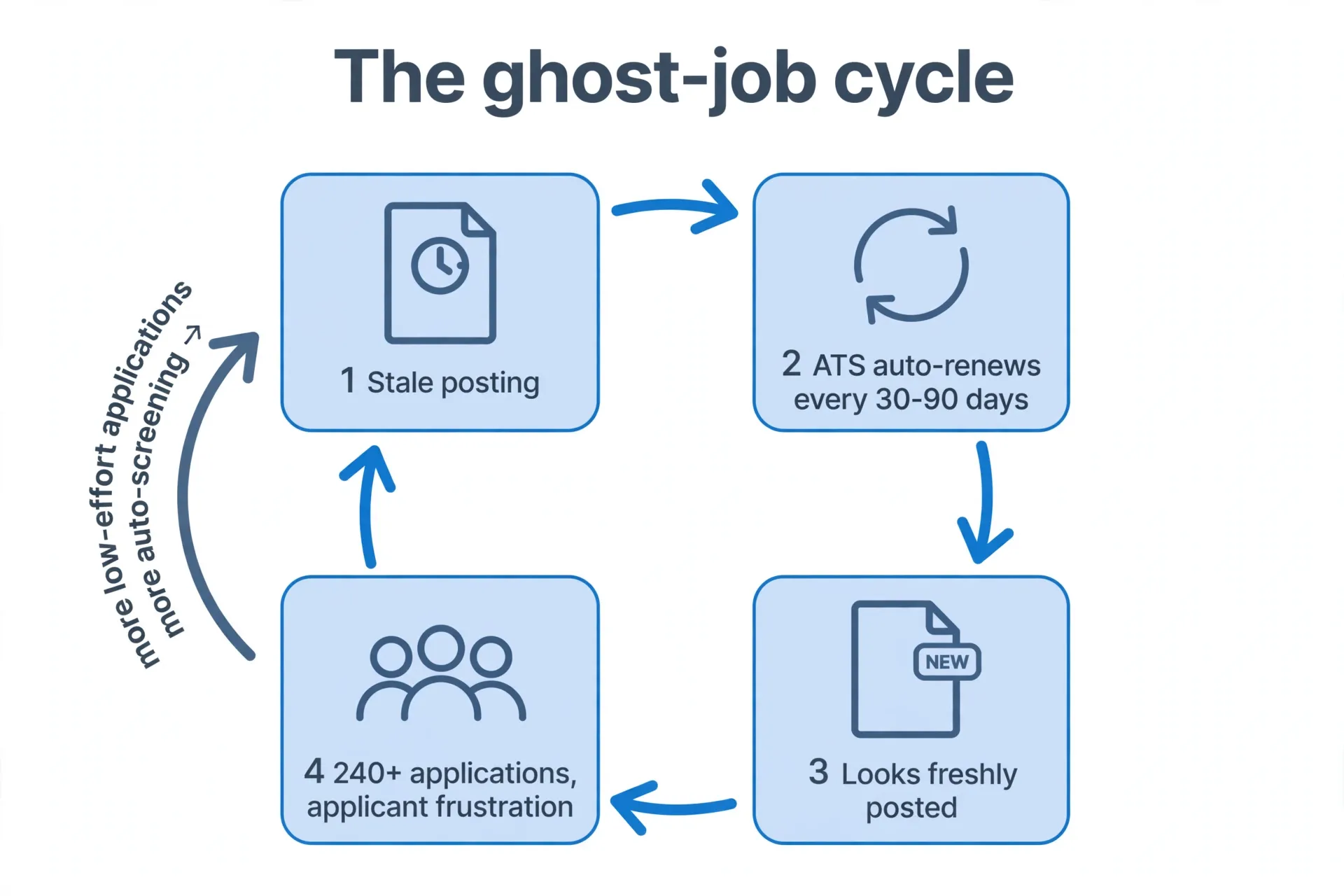
The mechanics are well-documented. Major ATS platforms (Workday, Taleo) auto-renew listings every 30–90 days, so a stale posting from months ago can look freshly posted today — which is exactly what tripped the probability up in the example above. Companies also keep postings live for talent pipelining, salary benchmarking, or because an internal hire is already decided, all without genuine intent to fill the role from the outside.
The applicant-volume side makes it worse: the average posting now draws roughly 240+ applications, a self-reinforcing loop where more automated resume screening produces more applicant frustration, which produces more low-effort mass applications, which produces yet more automated screening. A free web tool (GhostBust) already exists for exactly this problem — but as of our research, nothing packaged it as an Agent Skill you can run inside the same tool you’re already using to research the role and track your applications.
What it does
Four commands:
| Command | What it does |
|---|---|
/job-verify |
Estimates whether a posting is a “ghost job” from posting-age signals, re-post patterns, and company hiring-freeze news. A probability with reasoning, never a hard yes/no. |
/job-company-research |
Pulls recent company news, funding/layoff history, and public interviewer background ahead of an interview — and turns it into specific questions worth asking. |
/job-salary-check |
Live market-rate research for a role/location/level, cited, presented as a range rather than a single confident number. |
/job-track |
A lightweight, local job-applications.md tracker — log an application, update a status, see what needs a follow-up. |
Install
git clone https://github.com/ezcat207/job-search-intel-skill.git
bash job-search-intel-skill/install.sh --all| Flag | Installs into |
|---|---|
--claude |
.claude/skills/ |
--codex |
.agents/skills/ |
--grok |
.grok/skills/ |
--all |
All three |
For ChatGPT, upload the contents of a skills/<name>/ folder through ChatGPT’s own skill-upload flow.
Try the other commands
/job-salary-check Senior Backend Engineer, Austin TX, 6 years experience.

/job-track log: applied to Acme Corp, Backend Engineer, today.

/job-company-research Acme Corp, ahead of a Wednesday interview.
Why we didn’t build another resume skill
Search “SKILL.md job search” and you’ll find a mature, dominated space: Paramchoudhary/ResumeSkills alone has 22 sub-skills — resume tailoring, ATS optimization, cover letters, LinkedIn profiles, salary-negotiation prep — and 2,400+ stars. noamseg/interview-coach-skill has 2,200+. Building a worse version of either would help nobody.
What none of them are built for: things that need live web research or tracking state over time — the same distinction this site uses elsewhere between an agent that acts and a chatbot that answers. That gap is what this skill fills.
FAQ
Why isn’t there a resume-writing skill in here? Because that ground is already very well covered — ResumeSkills alone has 22 sub-skills and 2,400+ stars for resume tailoring, cover letters, ATS optimization, and LinkedIn profiles. Building another one wouldn’t help anyone. We built the research-and-tracking layer those tools don’t cover instead.
How accurate is the ghost-job detection? It’s a probability estimate from available signals (posting age, re-post patterns, company news), not a confirmed fact about any company’s hiring intent — the skill never outputs a hard yes/no, and says so. Treat a high estimate as a reason to deprioritize an application, not certainty that a posting is fake.
Does /job-track store my data anywhere outside my computer?
No — it maintains a plain markdown file (job-applications.md) in your own project folder. Nothing is sent anywhere else by this skill.
Could I sell this as a service to job seekers? There’s a real precedent for the idea on this site — our Jev resume-screening article covers the employer side of AI-assisted hiring, and candidate-side services (resume/LinkedIn optimization as a paid gig) are an established category on freelance platforms. This skill’s research/tracking angle isn’t the typical version of that gig, but nothing stops you from packaging it as one — that’s your call to make, not something this article prescribes.
References
- ezcat207/job-search-intel-skill — this skill’s source, MIT licensed.
- Paramchoudhary/ResumeSkills — the document-generation skill this one deliberately doesn’t duplicate.
- Glider AI — “Ghost Jobs in 2026” — ghost-job prevalence estimates.
- Metaintro — “Ghost Jobs Are Breaking the 2026 Hiring Market” — ATS auto-renewal mechanics, applications-per-posting figures.
- agentskills.io — the open Agent Skills standard.
Don't just read it — run the first job this week
Subscribe and get a 7-day validation checklist.
Subscribe free