International Student Arrival Checklist: Don't Miss Your School's SEVIS Deadline
Your school’s SEVIS check-in deadline is not the same as every other school’s — and a generic “international student checklist” you find online won’t know that. MIT’s International Students Office, for example, requires new students to complete an orientation eCourse and score 90%+ on its quiz before anything else unlocks; other schools run their check-in window differently. Miss your specific school’s process and it can hold up the DSO reporting step that activates your SEVIS record — the thing your legal status in the US actually depends on. This international student arrival checklist is an open-source Agent Skill built to catch exactly that: it produces a dated, school-specific timeline instead of a generic one, plus two other checks students consistently get stuck on in the first weeks. It is not immigration advice and it is not a counselor — more on those boundaries below.
Walkthrough: arriving 3 days before program start
Here’s what the checklist skill actually produces, not just what you’d type into it. Say a student — call her Priya — is arriving at MIT three days before her program start date.
Input:
/student-arrival-checklist I'm starting at MIT in September, arriving 3 days before the program start date.Output (illustrative — generated from MIT’s public ISO process):
| Priority | Item | Why it’s urgent |
|---|---|---|
| 🔴 Urgent — do before/on arrival | Complete MIT ISO’s orientation eCourse and score 90%+ on the quiz | Gates check-in; without it, later steps don’t unlock |
| 🔴 Urgent — real deadline | Check in with MIT’s International Students Office within its posted window after arrival | Triggers the DSO’s SEVIS reporting step; miss the window and your SEVIS record activation is delayed |
| 🟡 Can wait a few days | Apply for a bank account using passport + I-20 | Needs a US address first; not date-gated |
| 🟡 Can wait until eligible | Start SSN application | Requires authorized employment tied to an active SEVIS record — typically a 10–14 day wait after program start; applying earlier just gets rejected |
| ⚪ Background, no deadline pressure | Locate housing, academic advising, and career services contacts | Useful early, but nothing breaks if this happens week two |
The point isn’t the specific rows — it’s that the skill separates “this has a real, school-cited deadline” from “this can wait,” instead of handing you one flat generic list where everything looks equally urgent (which is how the actual SEVIS deadline gets buried).
The three problems this solves
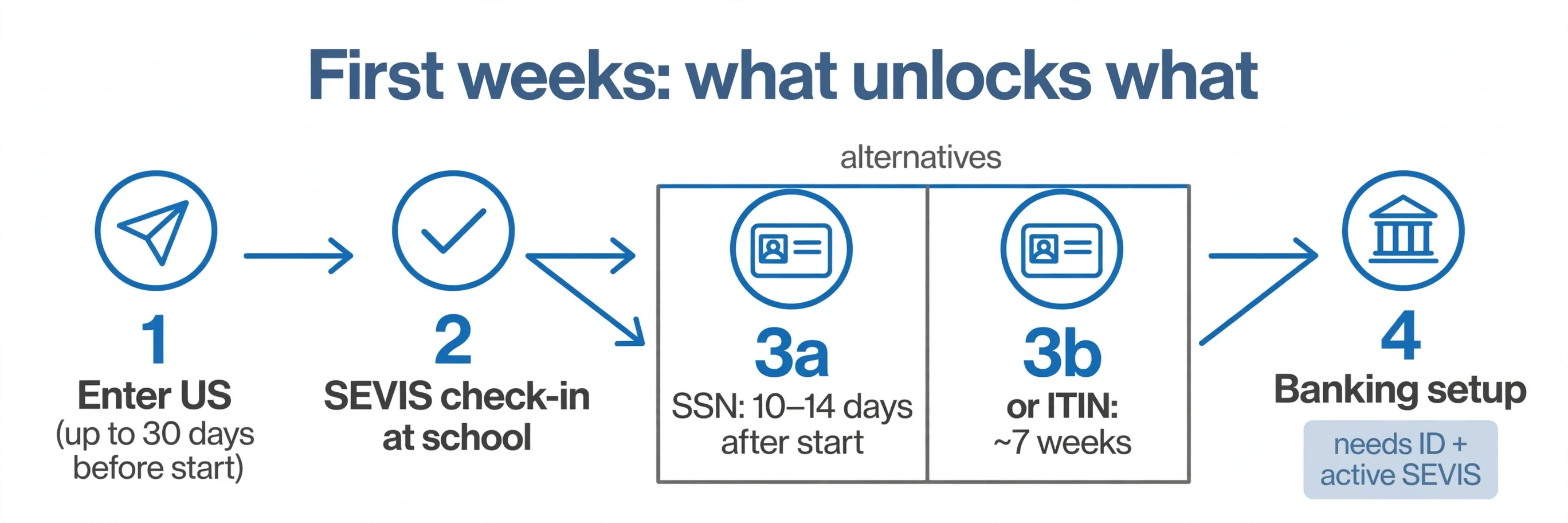
- SEVIS check-in deadlines that vary by school. Students may generally enter the US up to 30 days before their program start date; there’s typically a school check-in requirement within a window the school sets, then a DSO reporting step to activate the SEVIS record. A generic checklist misses school-specific requirements like MIT’s eCourse-and-quiz gate entirely.
- Banking without an SSN. Most F-1 students can’t get an SSN until they have authorized US employment, which itself requires an active SEVIS record — typically a 10–14 day wait after program start. Some use an ITIN instead (IRS Form W-7, roughly a 7-week process) for tax purposes. Bank policy on accepting a passport + I-20 as ID varies bank to bank and state to state.
- Not knowing who to ask. A confused student often doesn’t know whether their problem belongs to the international office, academic advising, housing, career services, or counseling — and asking the wrong office wastes time on something that’s already stressful.
What it does — and deliberately doesn’t
| Command | What it does |
|---|---|
/student-arrival-checklist |
Builds a personalized, dated timeline like the one above — urgent items (real deadlines) separated from lower-priority ones, school-specific where it can find your school’s actual process. |
/student-banking-setup |
SSN-vs-ITIN decision framework, what documents to bring, questions to ask a bank before visiting a branch. |
/student-campus-resources |
Given a described problem, routes you to the right office at your specific school. |
What it will not do, on purpose: give immigration legal advice beyond routine documented steps, attempt to provide mental-health support, or name one specific bank as “the” answer. Every immigration-adjacent output carries an explicit “not legal advice, confirm with your DSO” disclaimer, and anything sounding like homesickness or isolation gets routed straight to the school’s counseling center instead of an AI trying to help with it directly. For example:
/student-campus-resources I don't know anyone here and I'm feeling really overwhelmed.That prompt is exactly where you’ll see the skill stop and route you to your school’s counseling center rather than try to talk you through it itself.
Install
git clone https://github.com/ezcat207/student-arrival-skill.git
bash student-arrival-skill/install.sh --all| Flag | Installs into |
|---|---|
--claude |
.claude/skills/ |
--codex |
.agents/skills/ |
--grok |
.grok/skills/ |
--all |
All three |
For ChatGPT, upload the contents of a skills/<name>/ folder through ChatGPT’s own skill-upload flow.
Once installed, run /student-arrival-checklist with your own school and arrival date — it’s the same command used in the MIT walkthrough above.
Why we built this one
We checked first: searched the major Agent Skills directories and the web for anything covering international student arrival at US universities. As of our research (Sept 2026), corporate-employee-onboarding skills exist, but nothing specific to international students — no crowded niche to differentiate against, just a gap. So this was built from scratch, grounded in official school and government sources rather than assumption, with the two hard boundaries above (no immigration legal advice, no mental-health advice) built in from day one, not bolted on after the fact.
FAQ
Is this immigration legal advice? No, and it says so explicitly in every relevant output. It covers routine, publicly-documented SEVIS check-in steps and points you to your school’s international office (DSO) for anything beyond that, or an immigration attorney for anything that needs one.
Can it help with homesickness or culture shock? It won’t try to. If a conversation heads toward loneliness, anxiety, or feeling overwhelmed, the skill routes you to your school’s actual counseling center rather than attempting to counsel you itself — that’s a hard boundary we built in on purpose, not an oversight.
Does it tell me which bank to use? No. Bank policy on accepting a passport and I-20 instead of an SSN varies by bank and by state, and changes. It gives you the decision framework and the questions to ask a bank, not a named recommendation.
Why isn’t there an existing skill for this already? We looked, thoroughly — searched the major Agent Skills directories and the web. As of our research (Sept 2026), there genuinely wasn’t one. Corporate-employee-onboarding skills exist; nothing specific to international students at US universities.
References
- ezcat207/student-arrival-skill — this skill’s source, MIT licensed.
- MIT International Students Office — Getting Started — example of a real school-specific arrival process.
- CMU Counseling — International Students — on the documented, disproportionate adjustment strain international students face, and why routing to real counseling resources matters.
- agentskills.io — the open Agent Skills standard.
Don't just read it — run the first job this week
Subscribe and get a 7-day validation checklist.
Subscribe free