GPT-6.1 Sol: OpenAI's $4 Model vs the $20 Flagship — and How to Pocket the Difference
GPT-6.1 Sol: OpenAI’s $4 Model vs the $20 Flagship — and How to Pocket the Difference
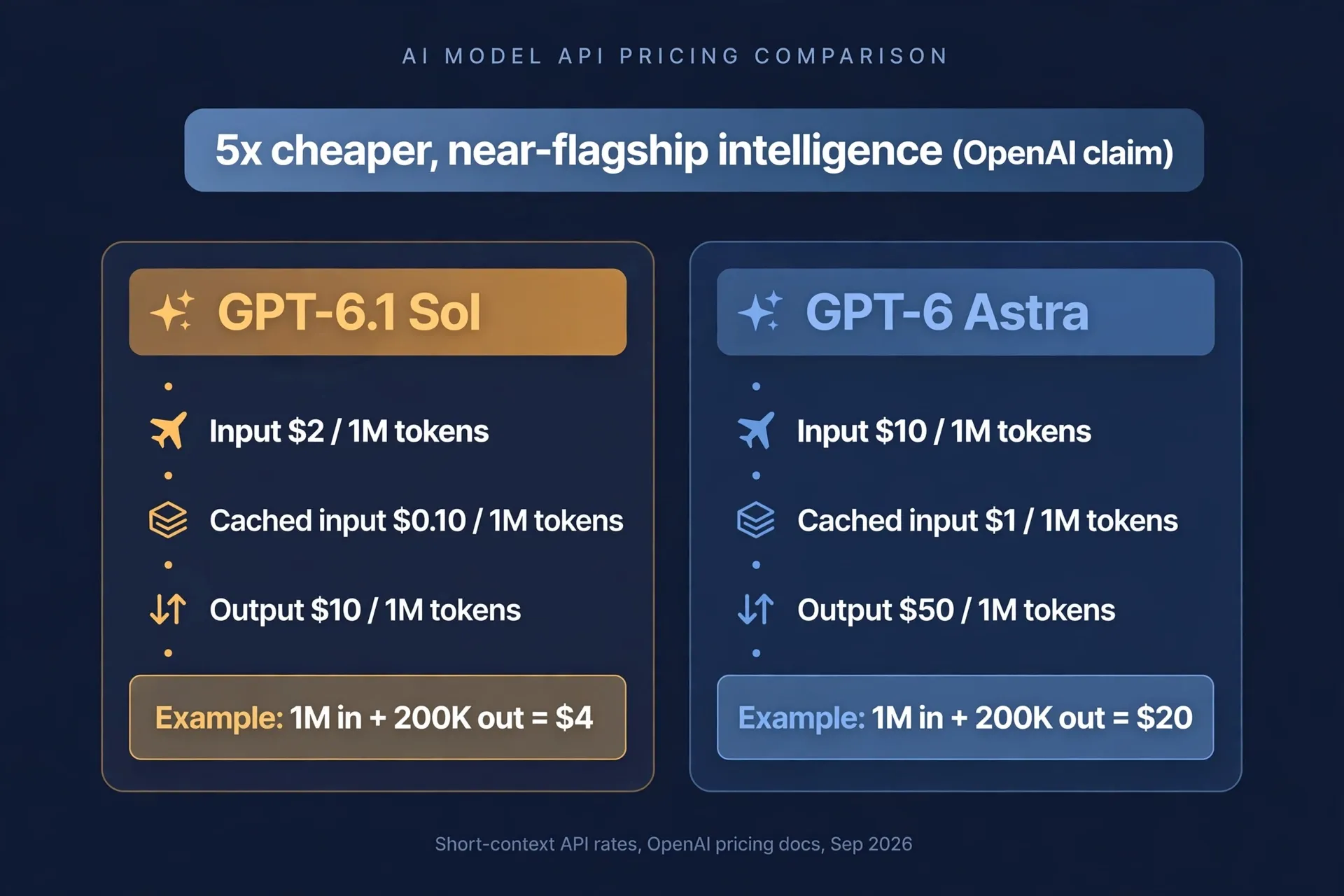
Picture this: you run a small AI tool — say, a resume-polishing bot with 3,000 paying users — and every month you stare at an OpenAI bill that eats 40% of your revenue. On September 29, 2026, the DevDay keynote quietly rewrote that bill. GPT-6.1 Sol, the cheaper sibling of flagship GPT-6 Astra, costs $2 per million input tokens, $10 per million output tokens, and $0.10 per million cached input tokens — about one-fifth of Astra’s list prices, with what OpenAI calls “near-flagship intelligence.” Run the headline math: 1M input + 200K output tokens costs $4 on Sol vs roughly $20 on Astra. Same workload, one-fifth the cost. This isn’t a benchmark story. It’s an arbitrage story: your cost floor just moved, and your competitors’ prices haven’t.
 Image: OpenAI
The price card — verified 2026-09-30
Prices below are from OpenAI’s official API pricing docs, cross-checked against launch-day reporting by VentureBeat, RuntimeWire, Neowin, and Unite.AI — they all agree.
| Per 1M tokens (short context) | GPT-6.1 Sol | GPT-6 Astra | Sol ÷ Astra |
|---|---|---|---|
| Input | $2 | $10 | 1/5 |
| Cached input | $0.10 | $1 | 1/10 |
| Output | $10 | $50 | 1/5 |
The worked example, line by line:
- Sol: 1,000,000 input tokens × $2/1M = $2.00; 200,000 output tokens × $10/1M = $2.00; total = $4.00
- Astra: 1,000,000 × $10/1M = $10.00; 200,000 × $50/1M = $10.00; total = $20.00
Two footnotes that protect you from a nasty surprise. Long-context requests (past roughly 272K input tokens) bill at a higher tier: Sol $4/$0.20/$15, Astra $20/$2/$75. And the first cache fill isn’t free — cache writes cost $2.50/1M on Sol. The 95%-off cache-read discount ($0.10 vs $2, halved from GPT-6 Sol’s $0.20) is the real killer feature for agents, because agents resend the same system prompt and tool definitions on every single turn.
What GPT-6.1 Sol actually is
The quick facts, no fluff:
- Announced at OpenAI DevDay 2026 (Sept 29, Fort Mason, San Francisco) — one week after GPT-6 Sol shipped.
- This release is an intelligence upgrade, not a price cut: it keeps GPT-6 Sol’s $2/$10 list price while, OpenAI claims, approaching Astra-level capability on coding, computer use, and professional work.
- API model id:
gpt-6.1-sol. Roughly 1M-token context window, up to 128K output tokens. - Available to Plus, Pro, Business, Enterprise, and Edu users in ChatGPT Work and Codex — explicitly not in regular Chat at launch.
- Why agents love it: the dominant cost line in a long agent session is re-reading the same context over and over. Halving the cached-input price attacks exactly that line.
“Near-flagship intelligence” — OpenAI’s claim, decoded
OpenAI’s official line: GPT-6.1 Sol “nearly matches GPT-6 Astra’s intelligence on agentic coding, computer use, and professional work at one-fifth of Astra’s standard input and output token prices.” That is OpenAI’s claim, not an independently verified fact. Here’s the evidence it rests on, and the salt to take it with.
OpenAI’s own evaluations (company-run, not independent):
- DeepSWE v1.1 (real-codebase engineering tasks): Sol matches Astra at roughly one-fifth the task cost, and beats GPT-6 Sol’s best score by 6.4 points.
- OSWorld 2.0 (computer use): within 2.1 points of Astra at roughly one-seventh the per-task cost.
- GDP.pdf (professional document Q&A): scores above Claude Opus 5.5 at less than half the task cost.
- AutomationBench (multi-step business workflows): 2.2 points above Opus 5.5 at about one-third the cost.
- Factual errors on deliberately hard prompts: cut from 11.4% (GPT-6 Sol) to 7.7%.
The one independent check we’ve seen: Artificial Analysis’s Intelligence Index rates GPT-6.1 Sol at 52 vs Astra’s 53, at about 22% of Astra’s cost per task — broadly consistent with the “near-Astra at a fifth” framing.
The honest caveats: Astra still wins outright on the hardest science benchmark (Terminal-Bench Science: Astra 68.1%, highest tested). Early community testers describe Astra as “more stable for complex tasks.” And per-token price is not per-task cost — token consumption is a behavioral property of the model, and a chattier model can erase a price advantage. Benchmark tables are a starting point; verify on your workload before you bet the margin on it.
Sol vs Astra: when to pick which
| Situation | Pick |
|---|---|
| High-volume agent loops, coding agents, document pipelines, batch processing | Sol — the economics are designed for exactly this |
| A human is waiting and every second costs you (live support, pair-coding) | Astra, or the Ultrafast tier at 6× the price |
| One-off, high-stakes reasoning: frontier research, complex legal drafting | Astra — still the top benchmark scores |
| You sell fixed-price subscriptions | Sol — your margin lives in the gap |
| Your pitch is literally “premium answer quality” | Test both; Astra’s edge is in the hardest ~5% |
The builder’s rule of thumb on launch day: Sol as the daily driver, Astra as the scalpel. Route the 95% bulk workload to Sol, escalate the 5% that actually matters to Astra. And note the trap: price per token ≠ cost per task. If your agent takes 30% more steps on the cheaper model, the “5× cheaper” headline shrinks fast — measure task completion cost, not token cost.
The money angle: cost arbitrage
This is why this article exists. Three plays, depending on where you stand:
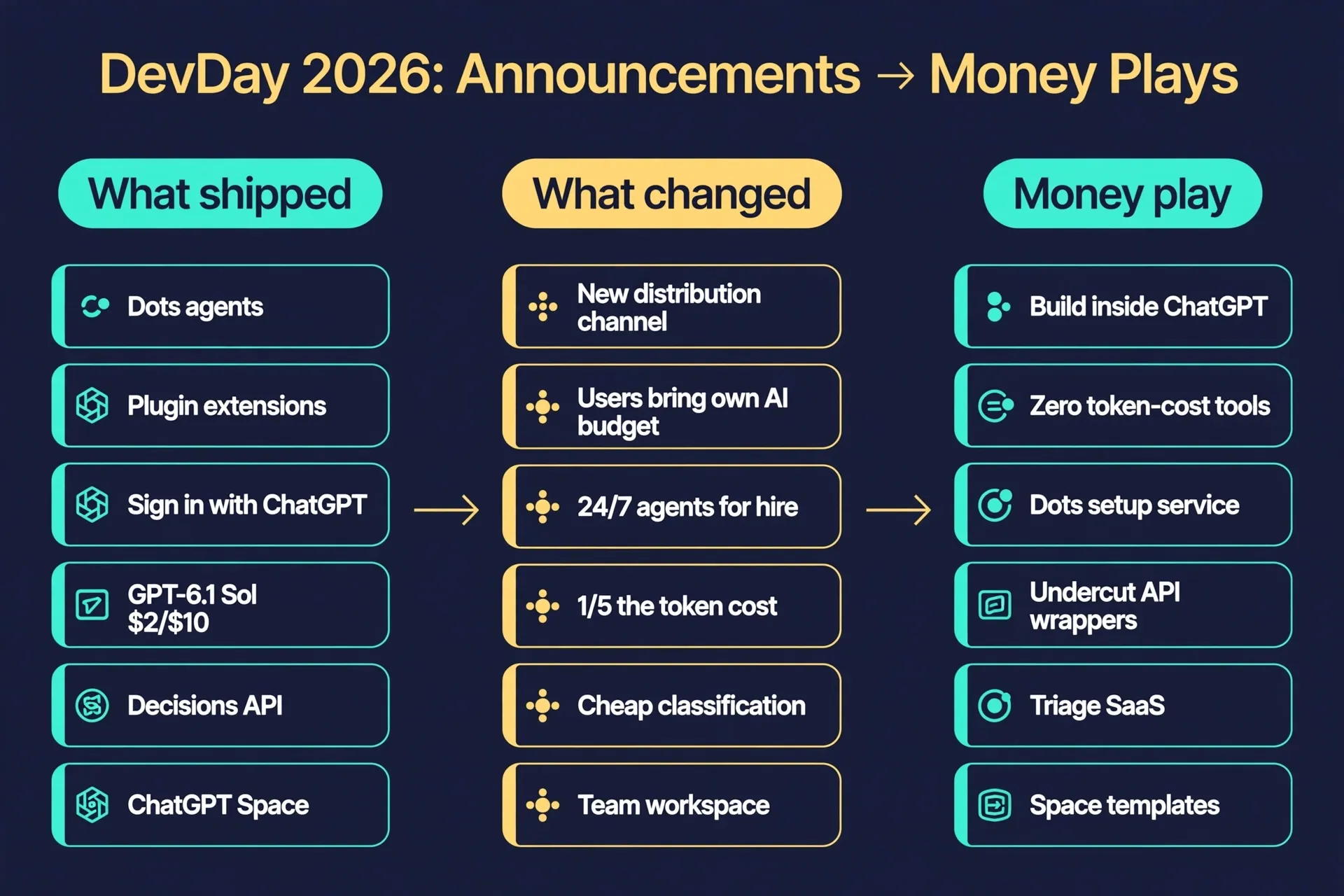
Play 1 — Already paying API bills? Switch and pocket the margin.
If your product burns $2,000/month in Astra tokens and Sol handles the workload, your new bill is roughly $400. That’s $1,600/month freed by changing a model id — after you validate quality. The safe move: route 10% of representative traffic to gpt-6.1-sol, diff the outputs, then flip. After the switch, two choices: keep your price and bank the margin, or cut your price 30% and bleed the competitor who hasn’t switched yet.
Play 2 — No product? Rebuild someone’s $49/mo wrapper at a cost basis they can’t match. Find an AI tool charging $29–$99/month that’s clearly a thin wrapper around a flagship model. Rebuild the same workflow on Sol + prompt caching. If their cost was $8/user and yours is $1.60/user, you can undercut them by half and still have fatter margins than they ever did. The Sol launch just handed you their cost structure on a plate.
Play 3 — Sell the switch as a service. Every agency and SaaS team with an OpenAI bill is a lead. Offer a “Sol cost audit”: benchmark their workload on both models, swap the model id, validate quality, and take a cut of the savings or a flat fee. Pitch template: “I cut your AI bill 80% in a week, or you don’t pay.” New capability, high willingness to pay, near-zero competition for the first few months — the classic agency window.
What to do this week
- Today: pull your last OpenAI invoice. Multiply the token totals by Sol’s rates. That number is your arbitrage — write it down.
- Tuesday–Wednesday: route 10% of a representative workload to
gpt-6.1-soland log quality side-by-side with your current model. Kill the experiment if quality regresses on the tasks that matter. - Thursday: if it holds, flip the bulk workload to Sol; keep Astra as the escalation path for the 5% high-stakes jobs.
- Friday: price one competitor’s product against your new cost basis. If there’s a 3×+ gap, you don’t have a feature — you have a business.
FAQ
What is GPT-6.1 Sol? OpenAI’s cheaper sibling of flagship GPT-6.1 Astra, announced at DevDay 2026 (Sept 29, 2026). It keeps GPT-6 Sol’s $2/$10 per-million-token list price while, OpenAI claims, approaching Astra-level performance on coding, computer use, and professional work.
How much does GPT-6.1 Sol cost? $2 per million input tokens, $10 per million output tokens, $0.10 per million cached input tokens in the API — verified against OpenAI’s official pricing docs on 2026-09-30. That’s one-fifth of Astra’s standard input/output prices ($10/$50) and one-tenth its cached-input price ($1).
Is GPT-6.1 Sol available in ChatGPT?
Not in regular Chat — it’s in ChatGPT Work and Codex for Plus, Pro, Business, Enterprise, and Edu users, plus the API as gpt-6.1-sol. (Last verified 2026-09-30.)
Is “near-flagship intelligence” independently verified? OpenAI’s own benchmarks say so (DeepSWE v1.1, OSWorld 2.0, GDP.pdf, AutomationBench), and Artificial Analysis’s independent Intelligence Index rates Sol at 52 vs Astra’s 53. Treat it as “consistent evidence from one independent source plus company claims” — not settled fact. Astra still leads on the hardest science evals.
When should I pick Astra over Sol? One-off, high-stakes, highest-difficulty reasoning — frontier research, complex legal work — and interactive loops where latency directly costs you money. Everything bulk and repeated goes to Sol.
What’s the catch with cached input pricing? The $0.10 rate applies to cached reads. The first write that fills the cache costs $2.50/1M, and long-context requests (past ~272K input tokens) bill at a higher tier entirely ($4/$0.20/$15 on Sol).
What’s Ultrafast, and does Sol get it? A premium speed tier (up to 300 tokens/sec) at 6× the standard price — live for Astra now ($60/$300 derived from the 6× multiplier, not separately published line items). GPT-6.1 Sol Ultrafast is listed as “coming soon.” Treat derived figures as derived, not confirmed.
References
- OpenAI — API pricing (official pricing docs): https://platform.openai.com/docs/pricing
- VentureBeat — OpenAI’s GPT-6.1 Sol offers Astra-like performance at 1/5th price: https://venturebeat.com/technology/openais-gpt-6-1-sol-offers-astra-like-performance-at-1-5th-price-a-new-ultrafast-tier-clocks-at-300-tokens-per-second
- RuntimeWire — OpenAI launches GPT-6.1 Sol at one-fifth Astra’s token price: https://runtimewire.com/article/openai-gpt-6-1-sol-cuts-frontier-model-pricing
- Neowin — OpenAI launches GPT-6.1 Sol with near-Astra performance at one-fifth the price: https://www.neowin.net/news/openai-launches-gpt-61-sol-with-near-astra-performance-at-one-fifth-the-price/
- Unite.AI — OpenAI unveils GPT-6.1 Sol at DevDay with new Codex and ChatGPT tools: https://www.unite.ai/openai-unveils-gpt-6-1-sol-at-devday-with-new-codex-and-chatgpt-tools/
- dev.to — OpenAI DevDay 2026: every announcement, with prices and availability: http://dev.to/axrisi/openai-devday-2026-every-announcement-with-prices-and-availability-1mbh
Don't just read it — run the first job this week
Subscribe and get a 7-day validation checklist.
Subscribe free