OpenAI DevDay 2026: 7 Ways to Make Money From the Announcements
OpenAI DevDay 2026: 7 Ways to Make Money From the Announcements
Every AI wave mints winners, and you hear about it late. In 2024 the GPT Store handed its early movers outsized traffic while the rest of us read the recap. Yesterday, OpenAI DevDay 2026 did it again: Sam Altman took the stage at Fort Mason in San Francisco and, in a single keynote, attacked the two hardest problems in the AI business — distribution and token costs. ChatGPT is becoming an app store (plugin extensions), and your users’ own subscriptions can now pay your AI bills (Sign in with ChatGPT). Run the math: 1M input + 200K output tokens on the new GPT-6.1 Sol costs $4 ($2 + $2). On flagship Astra pricing, the same workload is about $20 (~$10 + ~$10). Same work, one-fifth the cost — and that’s just the appetizer. Below: the 7 plays, ranked.
 Image: OpenAI
The three doors DevDay opened
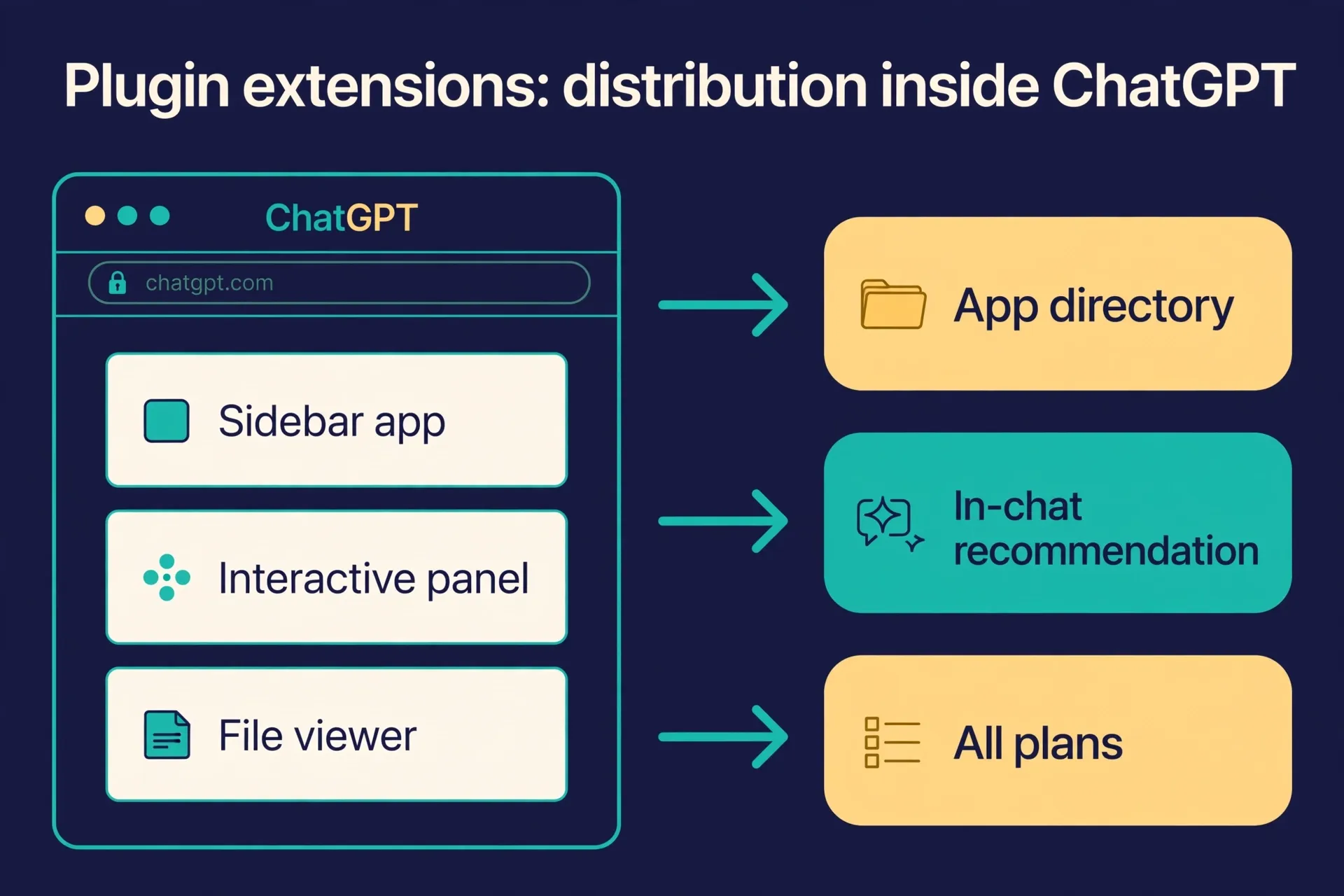
Door 1 — distribution, inside ChatGPT. Plugin extensions let developers build full applications that feel native to ChatGPT: sidebar destinations, interactive panels, file viewers. OpenAI distributes them through a directory and recommends them inside conversations when it detects a relevant need. The stage demos were Canva, Figma, Shopify, and a Meetings app. It works on all plans — the audience is the entire ChatGPT user base, not just Pro. Altman called them “essentially entire applications that feel native to ChatGPT.”
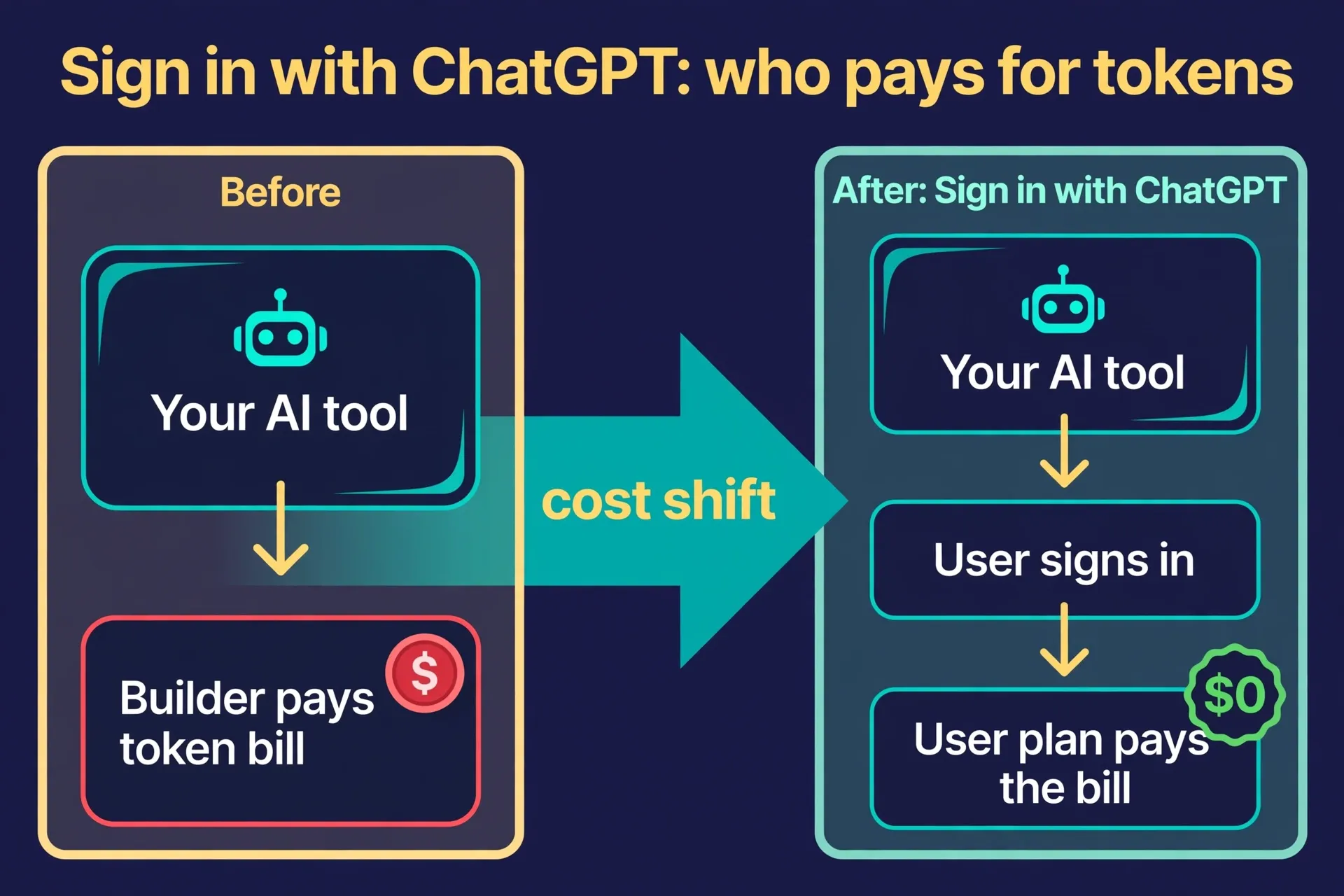
Door 2 — your users bring their own AI budget. Sign in with ChatGPT (plan usage): eligible AI usage inside participating third-party tools counts against the user’s Plus/Pro subscription instead of a separate bill. Sixteen to eighteen launch partners so far — mostly coding tools (Devin, Notion, Vercel, T3, OpenClaw, OpenCode, Warp, Conductor, Amp, Dactyl, Kilo Code) — which means non-coding categories are wide open. A separate website login (“Continue with ChatGPT”) is in limited trial.
Door 3 — agents that don’t sleep. Dots are always-on agents built on GPT-6 Astra, each with its own cloud computer and browser, 4,000+ app integrations, learning your work patterns and working 24/7. First dot included with Pro and Business Premium; Enterprise in beta. Alongside: ChatGPT Space and Pages (a shared team workspace) and Team Tasks (scheduled and event-driven automations).
YouTuber Greg Isenberg titled his DevDay breakdown “Dots, Agents & $100B Opportunities.” The number is hype — but it tells you how builders are reading this keynote: as a land grab, and the early claims go to whoever moves first.
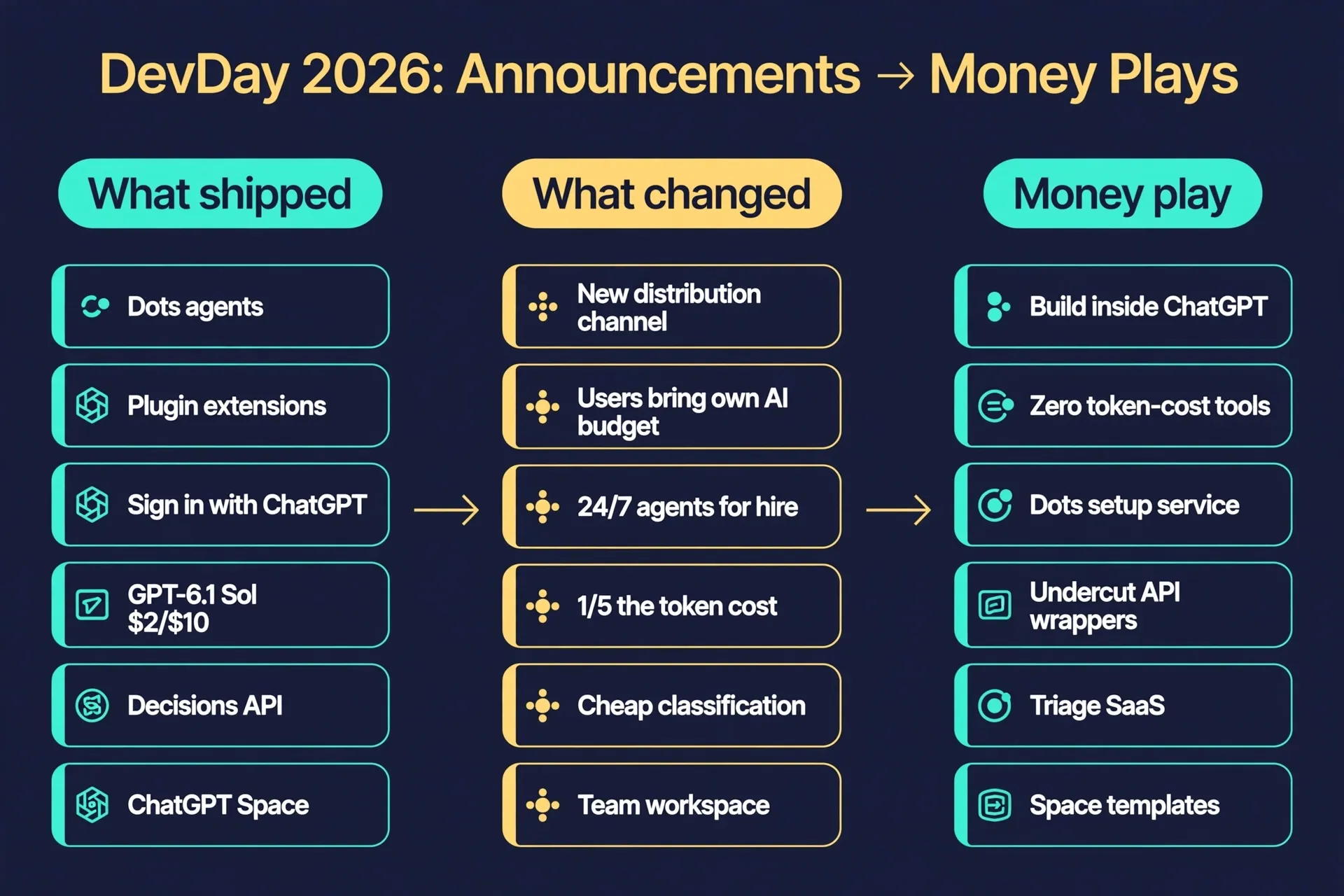
The 7 plays, ranked by money
1. Build a plugin extension — ChatGPT becomes your distribution channel
This is the platform move, and it’s the biggest door. Before DevDay, a ChatGPT plugin was a side feature. Now it’s a storefront with hundreds of millions of visitors, plus in-conversation recommendations doing your marketing for you — the closest thing to a new app store since the GPT Store in 2024, and the GPT Store’s early movers captured outsized traffic.
Money logic: distribution is the hardest, most expensive part of any app. If ChatGPT hands it to you, your customer acquisition cost collapses.
Who it’s for: developers and indie hackers who can ship a focused tool (a dashboard, an editor, a file viewer) in weeks.
2. Let your users’ ChatGPT plan pay your AI bill
“They’re already paying for an AI subscription, and now you don’t have to cover their token costs to get them going.” The unit economics flip: charge a flat subscription for your tool while eligible inference counts against the user’s plan — your token bill drops toward zero.
Money logic: AI wrapper margins have always been squeezed by token costs. Remove the cost and the margin belongs to you.
Who it’s for: builders of AI tools with heavy per-user inference (writing assistants, research tools, data tools). Caveat: it’s a limited preview with per-partner usage controls — read the preview limitations before betting the business on it.
3. Sell “Dots setup” as a service to businesses
Dots are powerful and confusing. Every business owner who watched the keynote wants one and has no idea how to configure it safely — it “asks before anything sensitive,” but someone has to define what’s sensitive. Package it: audit recurring workflows, configure dots + Team Tasks + MCP Events, hand over documentation, then charge recurring revenue to manage the fleet.
Money logic: the classic agency window — new capability, high willingness to pay, almost no competition for the first 3–6 months.
Who it’s for: automation freelancers and AI consultants — if you sold “ChatGPT for business” training in 2024–2025, this is your 2026 upgrade.
 Image: OpenAI
4. Build boring classification businesses on the Decisions API
The Decisions API (built on GPT-6 Luna) does one thing: fast, structured, pick-one-answer calls — triage this ticket, score this lead, moderate this comment. In limited preview.
Money logic: classification is the unsexy backbone of real SaaS (support triage, lead scoring, moderation, compliance). A cheap purpose-built decision endpoint puts your cost floor below competitors still routing every micro-decision through a flagship model.
Who it’s for: B2B SaaS builders. Start the waitlist and the workflow now.
5. Arbitrage GPT-6.1 Sol’s one-fifth price
$2 in / $10 out per million tokens — about a fifth of Astra pricing, for near-flagship intelligence (OpenAI’s claim). Every API wrapper and “GPT-powered” SaaS just got its cost structure rewritten overnight.
Money logic: two plays. (a) Already running an AI product? Switch to Sol and pocket the margin — or cut prices and bleed competitors. (b) No product? Rebuild someone’s $49/mo wrapper at a cost basis they can’t match.
Who it’s for: anyone already paying real API bills, and indie hackers who like cost-advantage plays.
 Image: OpenAI
6. Sell ChatGPT Space templates and setup packages
Space turns ChatGPT into a shared team workspace — shared knowledge, Pages, collaborative slides (coming), Team Tasks, even @ChatGPT in Slack/Teams. Teams will need the workspace designed: which pages, which plugins, which recurring tasks.
Money logic: the productized version of play #3 — sell template packs and setup packages instead of hours.
Who it’s for: Notion/Airtable template sellers. This is your next pack.
7. Be the explainer (content + affiliate)
Every DevDay opens a 2–4 week window where millions search “what is Dots,” “GPT-6.1 Sol vs…,” “how to build plugin extensions.” Tutorials and setup guides rank fast because day-one competition is thin. (This article is our entry in that window — full disclosure.)
Money logic: ad and affiliate revenue now, plus an audience that becomes the customer base for plays 1–6. Can’t build? Explain.
What to do in the next 7 days
- Today: read the official Sign in with ChatGPT docs and join the waitlist if your tool has real inference costs.
- This week: pick ONE play above — the one closest to skills you already have — and ship the smallest version: a plugin prototype, a Dots setup offer page, or a Sol cost-comparison post.
- This month: the early-mover window for plugin extensions and Dots services is 3–6 months. After that, it’s a crowded market again.
If this playbook was useful, bookmark it and subscribe to our newsletter — we’ll track which of these 7 plays actually pays out and report back with real numbers.
The rest of the launch list (one line each)
- Ultrafast — a speed tier up to 8x faster in Codex, 6x in the API; bundled with the new Pro 500 tier.
- Pro 500 — the name appeared on the keynote slide; $500/month is widely reported but not yet on OpenAI’s pricing page. Treat as reported, not confirmed.
- Decisions API — covered in play #4; limited preview, built on GPT-6 Luna.
- Agents API + computer use — public beta; the engine behind Dots, now open to builders.
- Codex in the cloud — Plus and up; close your laptop, the agent keeps going.
- OpenAI Marketplace — enterprises can spend existing OpenAI contracts on partner software.
- Codex Security Cloud + Private Intelligence — enterprise security plays; ignore unless you sell to big companies.
- Context: GPT-6.1 Astra itself was held back a day before the keynote over safety reviews — which is exactly why Sol, its cheaper sibling, is the model you can build on today.
FAQ
When was OpenAI DevDay 2026? September 29, 2026, at Fort Mason in San Francisco. OpenAI called it its biggest DevDay yet, with 20+ announcements.
What are Dots? Always-on AI agents inside ChatGPT, built on GPT-6 Astra. Each dot gets its own cloud computer and browser, integrates with 4,000+ apps, learns your work patterns, and keeps working 24/7. First dot included with Pro and Business Premium.
How much does GPT-6.1 Sol cost? $2 per million input tokens, $10 per million output tokens, $0.10 per million cached input tokens in the API — about one-fifth of GPT-6 Astra pricing.
What is Sign in with ChatGPT plan usage? Eligible ChatGPT Plus/Pro subscribers can use their existing plan allowance inside participating third-party tools (16–18 launch partners so far). The usage counts against their ChatGPT limits, so the tool builder doesn’t pay those token costs.
What are plugin extensions? Full applications built by developers that live inside ChatGPT — sidebar destinations, interactive panels, file viewers — distributed through OpenAI’s directory and recommended in conversations. Available on all plans.
Is the $500 Pro tier confirmed? The Pro 500 name appeared on the keynote slide and $500/month is widely reported, but we have not seen it on OpenAI’s pricing page yet — treat the price as reported, not confirmed. (Last verified 2026-09-30.)
I don’t code — is there anything here for me? Yes: plays #3, #6, and #7 need no code at all. Dots setup services, Space templates, and explainer content are all beginner-friendly entries into this window.
References
- Baader Agency — OpenAI DevDay 2026: Every Major Announcement: https://baaderagency.com/blog/openai-devday-2026-recap
- CellCog — OpenAI DevDay 2026: Everything OpenAI Announced: https://cellcog.ai/blog/openai-devday-2026/
- Reuters via europesays — DevDay 2026 live updates (plugin extensions, Pro 500, Ultrafast): https://www.europesays.com/ie/712119/
- RuntimeWire — Everything OpenAI announced at the DevDay 2026 keynote: https://runtimewire.com/article/everything-openai-announced-at-the-devday-2026-keynote
- Every.to — Vibe Check: OpenAI DevDay 2026: https://every.to/vibe-check/vibe-check-openai-devday-2026
- MadRobot — OpenAI DevDay 2026: Everything Announced: https://madrobot.blog/2026/09/29/openai-devday-2026-everything-announced-dots-gpt-6-1-sol-pro-500/
- dev.to — 5 DevDay launches that change what I build (plugin extensions, Sign in with ChatGPT): https://dev.to/aniruddhaadak5/i-watched-all-20-openai-devday-2026-launches-here-are-the-5-that-change-what-i-build-1g8p
- Bitcomme — ‘Sign in with ChatGPT’ as a way to use your subscription in third-party tools: https://bitcomme.com/openai-makes-sign-in-with-chatgpt-a-way-to-use-your-subscription-in-third-party-developer-tools/
- OpenAI Developers — Sign in with ChatGPT on your website (docs): https://developers.openai.com/siwc/website
- OpenAI Developers — Preview limitations (plan usage): https://developers.openai.com/siwc/token-sharing-open-source/preview-limitations
- Greg Isenberg — “OpenAI DevDay: Dots, Agents & $100B Opportunities” (YouTube): https://www.youtube.com/watch?v=Y_RevX5yMq8
- dev.to — every announcement with prices and availability: https://dev.to/axrisi/openai-devday-2026-every-announcement-with-prices-and-availability-1mbh
Don't just read it — run the first job this week
Subscribe and get a 7-day validation checklist.
Subscribe free