What Is Jev AI? The "System One Model" From TypeSafe, Explained
There’s a new name trending in AI circles this week: Jev AI. Some call it the model that “kills chat,” others call it the next great classifier, and someone’s already gotten it to play Doom. What is Jev AI, actually? This post covers it all in one place: who built it, how it works, what it costs, whether you can use it yet, and which of the marketing numbers deserve skepticism.
The one-line version: Jev AI isn’t a chat model — it’s a decision model
Jev is the first “System One Model” from TypeSafe AI, a San Francisco company, launched on September 15, 2026. Important: it is not an LLM and cannot chat — you can’t have a casual conversation with it or ask it to write an essay.
It does exactly one thing: you give it a chunk of unstructured state (a support ticket, a stream of user behavior), then ask it a few “questions with options,” and it returns typed, probability-scored decisions in a single call — which option was picked, the probability of each option, and a confidence score. The official tagline is: “unstructured state in, typed probabilistic decisions out.”
The name “System One” comes from Kahneman’s Thinking, Fast and Slow — System 1 being the fast, intuitive mode of human thought. TypeSafe’s ambition: give machines a fast, cheap “gut instinct” system dedicated purely to making calls, not to talking.
There’s also an easter egg in the name: Jev is short for Jevons, the economist behind the Jevons paradox — the idea that efficiency gains increase total consumption rather than reduce it. TypeSafe’s bet is clear: make decisions cheap enough, and usage goes up.
Who built it: a ChatGPT co-inventor and a $40M seed round
- Company: TypeSafe AI, founded 2024, headquartered in San Francisco.
- Founder: Diogo Almeida — a former OpenAI researcher, a co-inventor of RLHF and a co-author of InstructGPT. In other words, the reinforcement-learning-from-human-feedback approach behind ChatGPT has his fingerprints on it. His two co-founders are Erik Gafni and Sasha Sheng.
- Funding: announced alongside the launch in September 2026 — a $40 million seed round led by DCVC, at a valuation of roughly $200 million.
That background is worth pausing on: an RLHF co-inventor’s first model out of the gate is explicitly a “refuses to chat” model. That’s a signal in itself — even one of the people most responsible for making chat models work this well believes “decisions” should be pulled out of language entirely and turned into their own category of model.
How it works: three primitives — Choice, Score, Noul
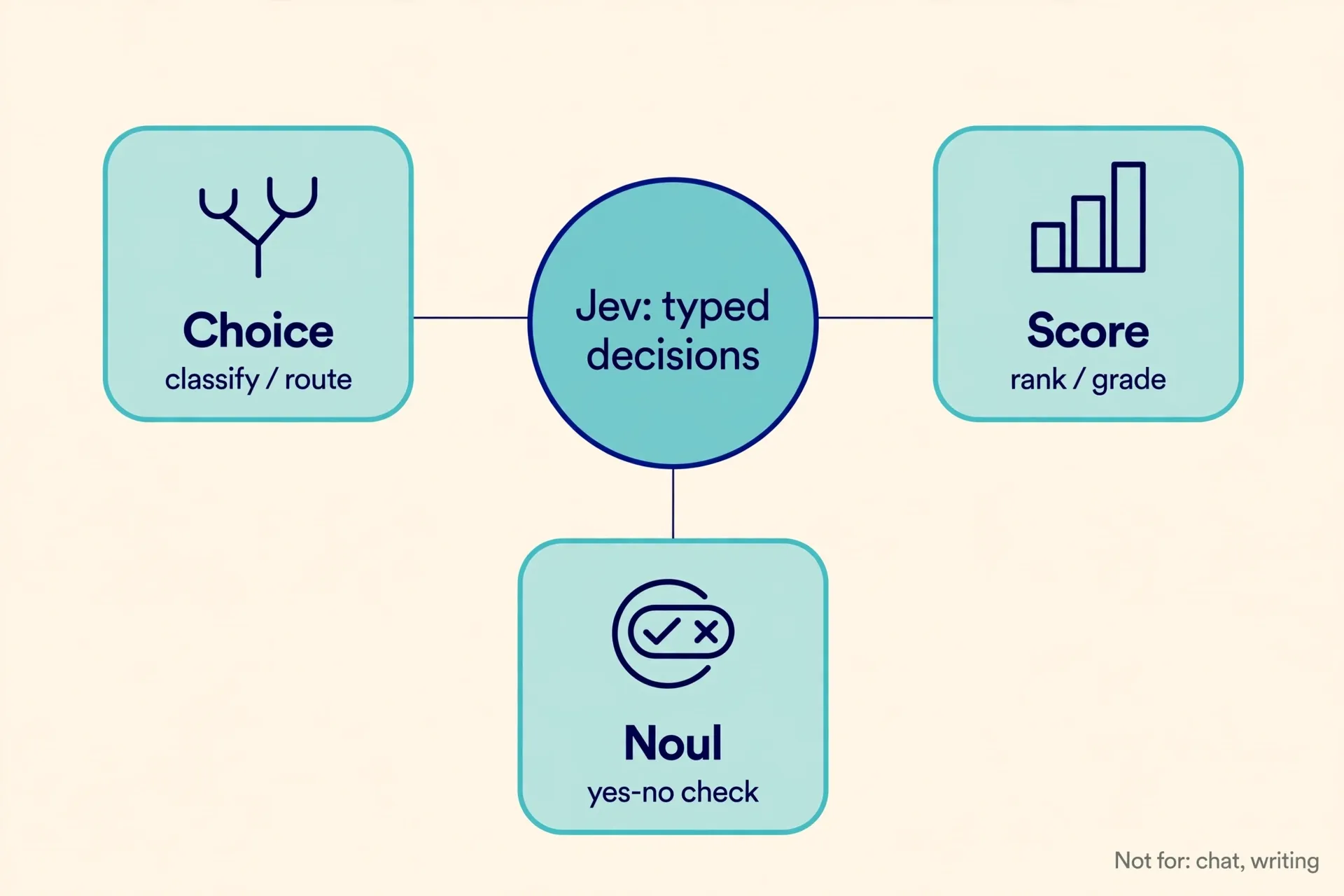
Jev’s entire API surface is three question types, which TypeSafe calls “primitives.” This isn’t a missing feature — it’s a deliberate design choice:
- Choice: pick one option from a set. Example: “which team should handle this ticket?” with options billing / technical / sales. Returns: which one was chosen, the probability of each option, and a confidence score. A single Choice supports up to 255 options.
- Score: place something on an ordered scale. Example: “how angry is this customer?” on a scale from calm-and-factual to mildly-annoyed-but-civil to very-angry. Returns a score that can land between levels (e.g. 1.035), plus the probability of each level and a confidence score.
- Noul: a yes/no question. “Noul” rhymes with “cool.” Example: “did the customer explicitly ask for a refund?” — returns a probability between 0 and 1; 0.92 means “92% likely yes.” There’s no confidence field here, because the number itself already represents the strength of belief.
Key point: all three question types can be asked in a single call, against the same input, and returned in parallel. LLMs generate text token by token; Jev returns decisions in parallel. That’s the source of its speed.
The training method is worth noting too: TypeSafe built a new method from scratch called RLCD (Reinforcement Learning for Calibrated Decisions) — this isn’t a fine-tuned LLM. The architecture and sampler are both new.
The key numbers: fast and cheap, but read the fine print
- Latency: 70–500ms per call, start to finish.
- Price: $0.042 per million input tokens, output is free. Note the reversal from LLM pricing — LLMs charge more for output than input; Jev’s output is just a handful of small numbers, so it doesn’t charge for it at all.
- The Doom demo: TypeSafe showed Jev playing Doom in real time, making decisions at 10Hz, at a cost of roughly $7 an hour. It’s an effective storytelling device — it turns “makes a decision in 70ms” into something you can actually watch.
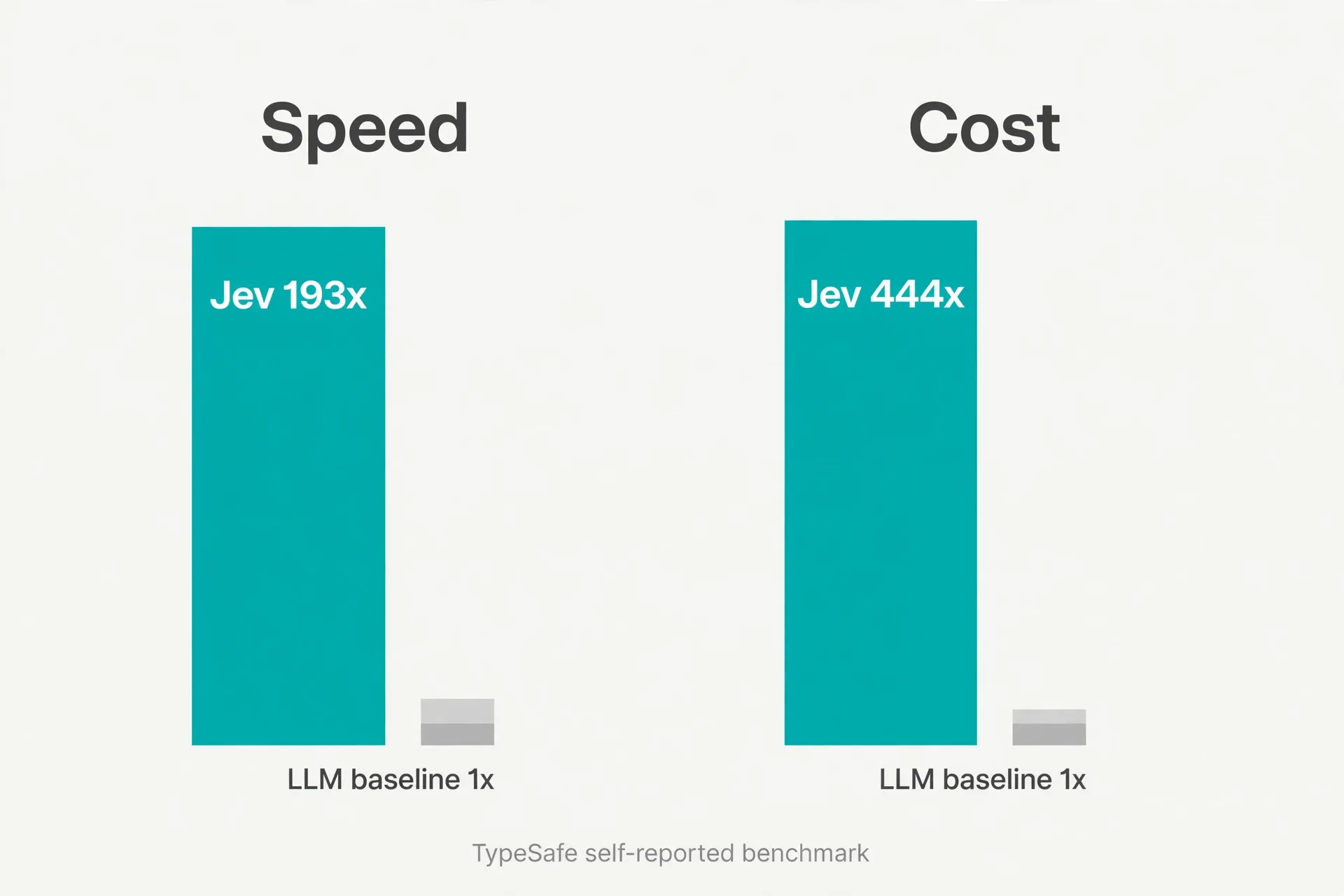
⚠️ An honest disclaimer (read this): the “193x faster, 444x cheaper than competitors” claims you’ll see are from TypeSafe’s own benchmarks — there is currently no independent third-party verification. Until someone independently verifies these numbers, treat them as a company’s claim, not established fact. The “doesn’t hallucinate” framing also deserves a discount: what Jev guarantees is valid output format (it can’t return anything outside the given options), not that it picks correctly. It’s entirely possible for it to confidently pick the wrong valid option. Type safety is not the same as being right.
How it’s fundamentally different from an LLM
| LLM (e.g. GPT/Claude) | Jev | |
|---|---|---|
| Output | Text, generated piece by piece | Typed values: options, probabilities, scores |
| Speed | Token-by-token generation, slow | Parallel decisions, 70–500ms |
| Use case | Chat, writing, reasoning | Classification, scoring, routing, validation |
| Hallucination risk | Can invent facts, drift off-format | Format can’t drift, but it can pick wrong |
| Pricing | Charges for both input and output | $0.042/M input, output free |
One line: an LLM is the mouth, Jev is the hand. The mouth talks, the hand decides. In future agent systems, the likely split is: the LLM thinks, Jev judges.
Can you use it yet?
It’s currently waitlist-only: apply for early access at typesafe.ai, and once approved, get an API key at console.typesafe.ai. There’s also an alternative that skips the waitlist entirely: it’s already available on Vercel AI Gateway (typesafe-ai/jev).
English-language tutorials have already been claimed by DataCamp and dev.to, but there’s essentially nothing on Jev yet if you look elsewhere. This is a first attempt at filling that gap. The next post covers the hands-on tutorial: from applying, to installing the SDK, to your first working call.
FAQ
Is Jev AI an LLM?
No. Jev is TypeSafe AI’s “System One Model,” purpose-built for structured decisions — it doesn’t generate text and can’t chat. Its input is unstructured state plus questions with options; its output is options, probabilities, and confidence scores.
Who built Jev AI?
TypeSafe AI, a San Francisco AI company founded in 2024. Founder Diogo Almeida is a former OpenAI researcher, an RLHF co-inventor, and an InstructGPT co-author. The company raised a $40 million seed round led by DCVC in September 2026.
Is Jev AI really 193x faster and 444x cheaper than an LLM?
That’s TypeSafe’s own benchmark number, with no independent third-party verification yet. Treat it as a company claim and stay cautious.
Can I try Jev AI for free right now?
It’s complicated right now — TypeSafe removed the waitlist entirely on Sept 20, 2026 and gave new accounts $5 free credit, then paused new signups two days later over demand. See our free-credit status page for the current state, or the alternative path via typesafe-ai/jev on Vercel AI Gateway. See our Jev AI tutorial: applying, calling the API, and the three primitives for the exact steps.
What is Jev AI good for?
High-frequency, low-cost decision tasks: support-ticket classification, sales-lead scoring, content moderation tiering, and validating an agent’s tool calls. It’s not suited for anything that requires generating text or an open-ended answer. To see how to turn this into income, read Making money with Jev: ticket classification, lead scoring, and agent routing.
References
- TypeSafe AI’s official site — source for the company, launch date (2026-09-15), the System One Model positioning, the waitlist application entry point, and the Doom demo; 193x/444x are self-reported benchmark figures published by the company.
- TypeSafe’s official docs — source for the three primitives’ (Choice/Score/Noul) API definitions, parallel calling, the RLCD training method, and pricing details.
Want to know how big the ecosystem is right now, or whether to self-host an open-source alternative: Jev Ecosystem Snapshot (2026-09-23) · Jev vs. Open-Source Alternatives
Don't just read it — run the first job this week
Subscribe and get a 7-day validation checklist.
Subscribe free