Jev Alternatives: 6 Open-Source Clones, LLM Classifiers, and When to Use Each (Oct 2026)
Jev Alternatives: 6 Open-Source Clones, LLM Classifiers, and When to Use Each (Oct 2026)
Yes, real Jev alternatives exist — and they fall into four buckets: (A) open-source Jev-like decision models you can self-host, several of them Jev-API-compatible; (B) Jev-compatible local servers that let you swap the base URL and keep your client code; (C) the incumbent Jev is trying to replace — big LLMs used as classifiers with structured output; and (D) traditional classifiers like XGBoost and fine-tuned BERT for fixed label sets. Which bucket wins for you depends on what you optimize for: cost, data control, accuracy, or simplicity. This is the catalog; for the full pay-vs-self-host math, see our pay or self-host analysis.
Bucket A: open-source Jev-likes you can self-host
The community moved fast — 6+ clones shipped within 48 hours of Jev’s launch (per explainx.ai’s sprint roundup), and the awesome-jev GitHub list now tracks 15+ alternatives. The table below leans on DataCamp’s 7-project comparison as its backbone:
| Model | Size & base | Standout trait |
|---|---|---|
| Laya | 322M–421M, ModernBERT-large + PPO (Apache 2.0) | Multilingual; laya-serve exposes a Jev-compatible API endpoint |
| Kev | 0.8B–9B, Qwen + LoRA + pointer head (Apache 2.0) | Closest Jev drop-in — the TypeSafe SDK reportedly works unchanged |
| Bespoke Nimble | 9B, Qwen3.5-9B + LoRA | Creator-reported 66% → 90% accuracy after data curation |
| Von | ~395M | Low latency on modest hardware |
| Decider | 2B / 4B / 35B MoE | Served via vLLM; pick your size-vs-quality trade-off |
| NanoJev | 0.6B | Full train → eval → serve pipeline in one repo |
Honest caveat, from independent testing: xbill’s “Jev After Eight Days of Independent Tests” dug into accuracy and calibration, and armanjr’s Jev-vs-Laya Persian benchmark had Jev winning 48/48 runs on repeatability. The fair headline is: Jev ≈ mid-tier LLM accuracy at ~1/200th the cost; open clones trail on calibration but are free and self-hostable. If you self-host, budget time for your own evals — don’t inherit the clone’s README numbers blindly.
Bucket B: Jev-compatible local servers (keep your client code)
Don’t want to touch your application code? These servers speak the Jev API, so migration is a base-URL swap: laya-serve, Arbiter, sys1 (written in Rust), and ollaya — billed as “Ollama for decision models,” released Sept 26. The self-hosting path (documented in a widely-shared dev.to walkthrough) is: pull a Bucket A model, serve it behind one of these, point your existing Jev client at localhost. This is the lowest-friction exit ramp if you prototype on hosted Jev and later need data sovereignty or zero marginal cost.
Bucket C: LLM-as-classifier (the incumbent Jev replaces)
Before Jev, “classify this” meant calling GPT-5.6 Terra/Sol or Claude Sonnet/Opus/Fable 5.1 with structured output and praying the JSON parsed. That stack is still the accuracy ceiling: on TypeSafe’s own eval — read that attribution carefully, it’s the vendor’s home turf — GPT-5.6 Sol hit 74.1% vs Jev’s 67.8%. But LLM classifiers run roughly 20–400x pricier per decision. You’re paying two orders of magnitude more for ~6 points. Sensible only when a wrong label is expensive (medical, legal, financial triage) and volume is low.
Bucket D: traditional classifiers (XGBoost, fine-tuned BERT)
Unfashionable, still undefeated for one shape of problem: fixed label set + labeled training data + no need for language understanding beyond the domain. A fine-tuned BERT or even XGBoost on embeddings will beat every option above on cost and often match them on accuracy — the price is you own training, retraining, and drift monitoring. Explainx.ai published a Jev-vs-XGBoost/BERT comparison if you want the numbers for this corner.
The honest math: accuracy vs. cost
This is the section most roundups skip, and it’s the one that determines whether an alternative actually saves you money or just moves the cost somewhere else.
The accuracy gap is real but narrow. On TypeSafe’s own eval — their benchmark, their home turf, so treat it as the vendor’s best-case framing — GPT-5.6 Sol scored 74.1% vs Jev’s 67.8%. The honest headline from independent testing reads: Jev delivers roughly mid-tier LLM accuracy at ~1/200th the cost. The open clones sit a half-step behind Jev on calibration and repeatability (recall armanjr’s 48/48 Persian benchmark), but they’re free to run.
Cost per million decisions, roughly:
| Option | Cost per 1M decisions | What you give up |
|---|---|---|
| Hosted Jev | $0.042/M input, output free (official) | Data leaves your infra; metered |
| Self-hosted clone (Kev/Laya) | ~$0 marginal (your GPU) | You own evals, calibration, uptime |
| LLM classifier | 20–400x Jev’s price | Nothing on accuracy — but the bill |
| XGBoost / fine-tuned BERT | ~$0 marginal (your infra) | Training, retraining, drift monitoring |
“Can’t hallucinate” ≠ “can’t be wrong.” This phrase gets repeated like a magic spell, so let’s deflate it precisely: it means the model cannot emit out-of-schema output — every answer is a valid label from your set. A valid label can still be the wrong label. Jev doesn’t remove the need for evals; it removes one specific failure mode (unparseable JSON, invented categories). If your use case punishes wrong labels rather than malformed ones, calibration testing matters just as much as it did before.
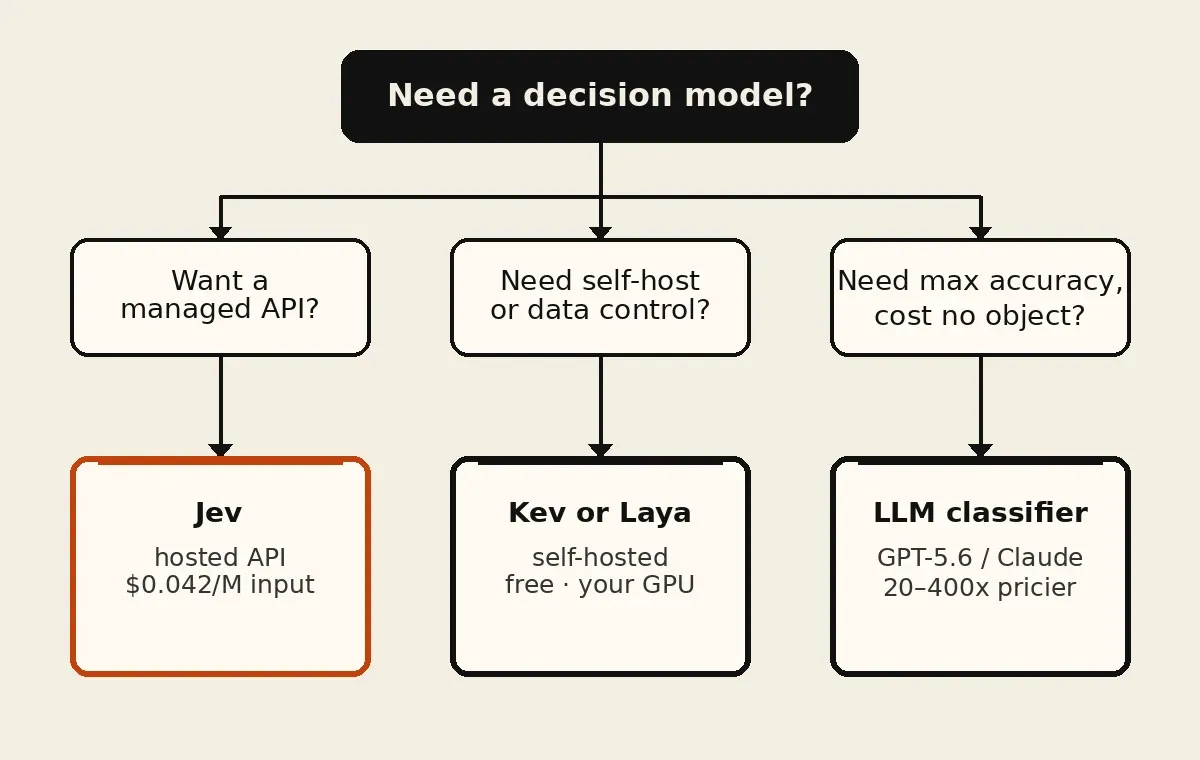
When to pick what: the decision guide
- Prototype this week, no infra → Hosted Jev. Start with the $5 credit, follow how to use Jev, ship the thing.
- Volume is scaling or data can’t leave your VPC → Self-host Kev (closest drop-in) or Laya (multilingual) behind a Bucket B server. Inference cost drops to ~$0 marginal on your GPU.
- A wrong label costs real money, volume is low → LLM classifier (GPT-5.6 Sol / Claude) with structured output. Pay the 20–400x premium deliberately.
- Fixed labels, labeled data, stable domain → XGBoost / fine-tuned BERT. Boring and cheap wins.
- Already built on Jev and just want out of the meter → Bucket B server swap; keep every line of client code.
Switching off Jev later: the migration checklist
If you prototype on hosted Jev and migrate to a self-hosted clone, do it in this order — each step is reversible until the last:
- Freeze your eval set first. Save 500–1,000 real decisions with Jev’s outputs as your baseline before you touch infra. This is the yardstick every clone gets measured against.
- Stand up a Bucket B server locally (laya-serve or ollaya) with Kev or Laya behind it. Point a staging copy of your client at the new base URL — production keeps hitting Jev.
- Run the eval set through the clone. Compare accuracy and calibration (confidence scores, repeatability across runs) — the two axes where clones trail, per independent tests.
- Shadow-run in production for a week. Send live traffic to both, log disagreements, eyeball the ones that matter. If disagreement rate is acceptable for your use case, cut over.
- Cut the meter. Flip the base URL in production. Keep the Jev key around for a month as a rollback lever — $5 of credit is cheap insurance.
The money angle: alternatives are the margin lever
Here’s why this page exists on a money site: the alternative IS the business model. Jev’s hosted price — $0.042 per million input tokens, output free (per TypeSafe’s official docs) — is already cheap. But “cheap” at 100M decisions a month is still a line item, and some clients legally can’t send data to a third-party API at all.
The playbook that falls out of the buckets above:
- Prototype on Jev’s $5 credit. Validate the use case, find product-market fit, get your first paying user. Zero infra.
- Scale on hosted Jev while unit economics work. It’s the fastest path and the accuracy is honest.
- Self-host Kev/Laya when volume or data rules demand it. Your inference cost goes to ~$0 marginal (your GPU, your electricity), your margin on the same “sell the system” contract jumps — and you gain a compliance story (“your data never leaves your infrastructure”) that wins regulated clients hosted Jev can’t touch.
That last point deserves emphasis because it’s the highest-leverage sales line in this whole page: data sovereignty is a feature you can charge for. Healthcare, finance, and legal clients often cannot use a hosted classification API no matter how cheap it is. A self-hosted Kev behind a Bucket B server inside their VPC turns a compliance blocker into your moat — and lets you price on value (risk removed) instead of competing on per-token cost. One such client at a $2–5k/month retainer beats a hundred hobbyists on the meter.
That’s the same service business either way — the full version lives in the money playbook — but the clone path turns a 60% margin into a 90% margin. Start at the Jev Hub if you’re still mapping the territory.
References
- DataCamp — top open-source Jev alternatives (7-project comparison table): https://www.datacamp.com/blog/top-open-source-jev-alternatives
- explainx.ai — six Jev clones in two days (the 48-hour sprint): https://www.explainx.ai/blog/six-jev-clones-two-days-2026
- dev.to — open-source Jev alternatives you can self-host (Jev-compatible endpoint walkthrough): https://dev.to/yanng981/open-source-jev-alternatives-system-one-models-you-can-self-host-i5e
- TypeSafe docs — official Jev pricing ($0.042/M input, output free): https://docs.typesafe.ai/models
Don't just read it — run the first job this week
Subscribe and get a 7-day validation checklist.
Subscribe free